Tuesday, July 16, 2013

Still not really happy with Feedly

For the most part, Feedly has been a successful "replacement" for Google Reader for me.

It makes me nervous that Feedly is not as open as Google Reader was, so I'm not really sure I'll be able to recover my subscription lists, etc., down the road.

Feedly rather frequently fails to format articles properly; its most common failure mode is to spray raw HTML across the page, which I assume is some sort of mis-communication about MIME types with the underlying feed it's reading.

Feedly's algorithms for marking articles as "read" when I scroll through them seems to be quite delicate, and often it will re-present articles that I have already read, insisting that I haven't read them yet.

And sometimes Feedly just acts eccentric, for example pulling out an article from 2010 on one of my feeds and showing it to me as "new, 10 hours old".

I'm sticking with Feedly for now, but I'm interested to know whether any of the alternatives are gaining any traction.

Saturday, July 13, 2013

What happened to MOL Comfort?

I've been busy recently, and am just catching up with things of interest.

One of those items is the loss of the container ship MOL Comfort, which was not your ordinary sea-going vessel:

With an overall length of 316 metres (1,037 ft) long, moulded beam of 45.6 metres (150 ft) and fully laden draught of 14.5 metres (48 ft), MOL Comfort was too large to transit the Panama canal and was thus referred to as a post-Panamax container ship. She measured 86,692 in gross tonnage and 48,825 in net tonnage, and had a deadweight tonnage of 90,613 tonnes. The container capacity of the ship, measured in twenty-foot equivalent units (TEU), was 8,110 of which 4,616 TEU is stored on the deck and 3,494 TEU in the holds.

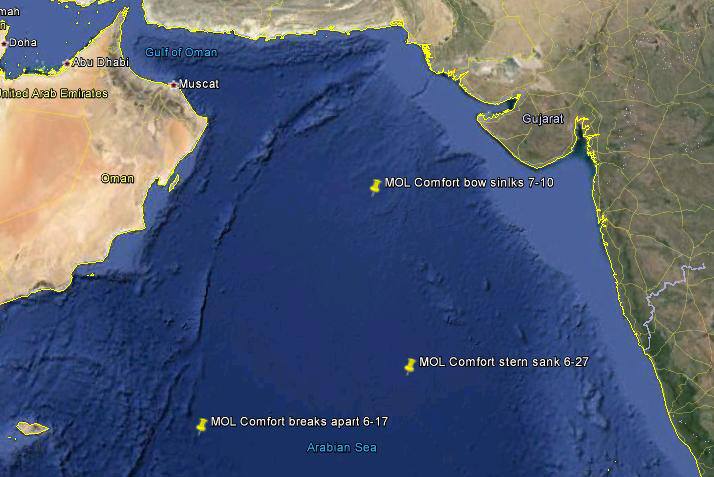
But on June 17th, while carrying 4,500 cargo containers from Singapore to Jeddah, MOL Comfort's hull cracked, and the ship separated into two pieces. The 26 crewmembers were all rescued, which itself must have been eventful, since the conditions were reported to be that "waves rose to six metres and were accompanied by strong winds."

Salvage companies responded, and at one point they had attached a tug boat to one section of the damaged ship, and were trying to tow it toward shore, but that effort ultimately failed and the entire ship was lost.

"Burnt containers and other debris are floating around the vicinity and all vessels have been advised to avoid any sea mishap," a coast guard official said.

Blog site gCaptain has collected some amazing pictures of the events here, and they've also got a nice map to help you understand where this all took place.

Early speculation centered on what might have caused the hull of the nearly-new ship to crack like this.

Ships are designed to handle long period and large waves that crest on the bow and stern and have a trough amidships. This creates a sagging situation that puts extreme tension on the keel and compression at deck level. The opposite, “hogging” situation occurs when the crest of the wave moves to the center of the ship and the trough of the waves are at bow and stern.

The repeat flexing of the ship in these perfectly timed waves is likely what caused the loss of this vessel.

But since this is precisely what gigantic cargo container ships are designed to handle, there must have been other contributing factors. Additional speculation suggests that overloading of containers is a common situation in the shipping industry:

How on earth does a 5 year old 90,000 ton containership, built by one of Japan’s finest shipyards and operated by a tip-top liner company, come to be floating in two bits 19 miles apart? Weather? Welding?

One of those 100 year waves the Met. Offices are warning us are rather more frequent?

The smart money must surely be on the stresses induced by under-declared container weights, which shippers routinely refuse to take with any seriousness whatever.

The inspection firm which oversaw the ship's construction is investigating what went wrong, and noted that they had just surveyed the ship at the end of May, and found no abnormalities. As they note with carefully chosen language, further investigation will be challenging to do, since the boat completely sank:

ClassNK, which classed the five-year old vessel, is working in conjunction with Mitsubishi Heavy Industries and Japanese government authorities to investigate the cause of the casualty. Lloyd’s Register has also been appointed to investigate the cause as a neutral third party.

However, the loss of the remaining part of the hull on 11 July means investigators have much less evidence to work with. "In view of these unfortunate circumstances, the ClassNK Casualty Investigation Team will expedite the investigation into the cause of the incident, and expects to consolidate its preliminary findings by early September 2013."

"ClassNK will continue to make every effort to determine the cause of this incident, and will work to ensure that the results of the investigation are used to secure greater safety for the maritime industry," the Japanese class society added.

In the meantime, the six MOL Comfort sisterships will be retrofitted

The work, to be conducted on MOL Creation, MOL Charisma, MOL Celebration, MOL Courage, MOL Competence and MOL Commitment, will increase the vessels’ hull strength twice over, despite already meeting the International Association of Classification Societies (IACS) hull strength criteria.

This is certainly an interesting story; I'll try to pay attention to see what additional information is released as the investigators continue their study.

The Everest Brawl

Catching up on some reading recently, I came across an article highlighting an incident from 3 months ago that had slipped past without my noticing: Nick Paumgarten's The Manic Mountain: Ueli Steck and the clash on Everest..

Steck is a very famous, but rather independent-minded and isolated climber. Paumgartens notes that

He'd kept his plans secret. He has long disdained revealing the details of expeditions in advance. He doesn't indulge in what he calls "tasty talking" -- boasting of feats he has not yet accomplished. Also, a climber must generally be discreet about a bold route, to prevent other climbers from going there first. He was not displeased when climbing blogs reported, incorrectly, that he was going up the South Face. He had something else in mind.

I'm not quite sure what that "something else" was, but it apparently involved (a) speed climbing, (b) "alpine style" mountaineering, with no fixed protection and no porters, and (c) minimal use of supplemental oxygen. Blogger Peter Shelton reports that

Their goal was an unprecedented enchainment linking the Hornbein Couloir, the summit of Everest, and the summit of Lhotse in one fast-and-light push, once their camps were set and they had acclimatized.

Regardless, what clearly happened is that Steck and his two companions embarked on the fairly standard climb of the Lhotse Face, which involves ascending from Camp 2, at 21,300 feet, to Camp 3, at 24,500 feet.

Unfortunately, they chose to make this ascent on the day that the main climbing teams had chosen for establishing the "fixed ropes" on the Lhotse Face.

April 27th was the day that a team of Sherpas were installing the fixed rope. It is an essential and difficult job, involving heavy gear and extreme working conditions on an ice cliff riddled with crevasses.

It's hard to get the concept of this without some visuals, so try this nifty QuickTime VR panorama, or the pictures on this great blog entry.

So, that sets the scene. But then what happened?

In an interview with the Swiss Broadcasting Corporation, Steck describes it as follows:

We know they were fixing the lines and we were not touching their lines and we did not interfere. They were fixing the ropes for the commercial expeditions and not for us because we don’t need it. Of course, we have to leave space for everyone on the mountain. So we went 50m to the left so we would not disturb them and we were really careful not to knock any ice down. We did not disturb them at all.

In an interview with National Geographic, Steck's climbing companion Simone Moro describes it as follows:

When we arrived on the Lhotse Face, the Sherpas fixing rope there told us to turn back and go home. But we told them that we weren't going to disturb them or hang on the fixed ropes, as they probably assumed. Then we immediately climbed Alpine style, without a rope, 100 meters to the left of them. They threw a piece of ice at us to scare us. But we didn't react. We continued climbing to the left of them.

50 meters, 100 meters, who knows? I don't think they stepped it off. Clearly they are roughly telling the same story.

But then there arises the critical incident, which Paumgarten does his best to describe very clearly:

After an hour, Steck and the others reached the level of Camp 3, where they would have to traverse the face to get to their tent, which meant they needed to cross over the fixed line. They chose a spot where four Sherpas were at the belay, below the lead fixer, and moved slowly past them, taking care, Steck says, not to touch the rope with their crampons or to kick chunks of ice onto the Sherpas working below. After Steck crossed the line, the leader of the fixing crew, Mingma Tenzing Sherpa, who was working fifty feet or so up the face, began yelling at Steck and banging on the ice with his axe. Mingma, a young man from the village of Phortse, then rappelled down toward Steck. Anticipating a collision, Steck raised his arms to cushion the blow and prevent himself from being knocked off the phase. According to Steck, Mingma rappelled into him, then began yelling at him for having touched him. He accused Steck and his team of kicking ice chunks loose and injuring a member of his crew.

"After an hour"? Wow! To appreciate this, you have to understand that the normal climbers, who are climbing using the fixed ropes, take an entire day to make this ascent.

At any rate, at this point, I think it's important to pause for a moment and observe that not only was 2012 one of the deadliest years ever on Mount Everest, but just 2 weeks earlier one of the top Sherpa guides had died in a climbing accident

So perhaps the Sherpa team was a little bit tense.

But undeniably things go downhill very quickly at this point. Simone Moro's recollection of the events continues:

He was screaming at all of us. Because the first of us making the traverse was Jon Griffith. The second was Ueli Steck. And the third was me. He was screaming at all of us. When we got close to him, without saying, "Hello, ciao, how's it going? It's cold and windy," he immediately started to scream. Very nervously. Very angry. And, I repeat, waving an ice ax. So I also screamed myself, after 30 seconds, saying the exact words in Nepalese, "Mother******, what are you doing?" Because he was waving the ice ax close to us and we were not roped. If he touched me, I would fall down the whole face of Lhotse.

This is the only thing that I can say I'm sorry for. I said, "Mother******, what are you doing?" And he said, "We are fixing rope!" And we told him, "Okay, if you want, we can help you. Okay?" Because it was getting cold and windy. "If you want, we'll go and stop at our tent here, come back at 1:00, and if you want [us] to, we can also help you to do your job."

"No, no!" And he came very close to Ueli Steck. There was a physical contact between them because, when he was going toward him, waving the ice ax, at a certain moment, Ueli was retreating but also losing his balance. So Ueli touched, physically, the Sherpa, but just to keep himself from falling. And the Sherpa said, "Why you touch me? Why you touch me?" And Ueli said, "Listen, we are here all together for the same aim. If you want, we can help you to fix rope." And the Sherpa said, "No, I don't want that. Now we stop. We go down."

As Paumgarten notes, this is an amazing and complicated story already, but we haven't even reached the real incident:

When the European climbers got back to their tents, at the upper edge of Camp 2, they were greeted by an American named Melissa Arnot, who'd been sharing their camp and who was attempting a fifth conquest of the summit, more than any other woman. She warned them that the Sherpas were very angry about the incident on the Lhotse Face and that the mood in camp was volatile. She left, but after a few moments she ran back to their tent to say that a large group of Sherpas had set out from the main part of camp. She said, "I think you should run."

"I think you should run" ? My mind boggles. You're at Camp 2 on Everest, in the evening, after a day of climbing. Run where? Run how? Steck says only that

there is no point in fighting back if you have 100 people against you. The only thing you can do is take the beating. Simone and Jonathan managed to run away but I was not fast enough (I am getting slow and old). I was in a tent and I was alone. The discussion outside the tent went on for about one hour and Melissa and Greg of IMG [International Mountain Guides] tried to calm them down but all I could hear was them shouting “Give us the guy. We will kill him first and then the other two”

Happily, nobody is killed, and nobody dies.

Somehow they managed to calm them down. Simone had to apologise on his knees for his bad words on the mountain. So they gave us one hour to leave the mountain and told us never to come back again.

All in all, it's an amazing story.

In the intervening months, a number of commentators have attempted to make sense of it all.

The Telegraph is one of many to suggest that simmering resentment bubbled over: What drove 100 Sherpas to attack Western climbers on Everest?

You see rudeness towards them all the time, and it greatly upsets me – people are dismissive, or expect their food and clothing to be carried for them. Some of it is unintentional cultural offences, but other times it is blatant rudeness.

Moro, who after all was there, and who perhaps provoked it all by swearing at the Sherpas in Nepali, suggests that they were jealous of Steck's skill and ease on the mountain, and felt that it embarassed them:

Probably, on a cold, windy day, the leader of the rope-fixing team who saw three foreigners, who climbed in one hour what they climbed in half a day, without a rope, coming to them and offering to help them, probably it provoked jealousy or a kind of envy. Not everybody likes admitting that there is someone faster than you or better than you, okay?
Moro also suggests that people like himself threaten the Sherpa livelihood, financially:
people like us, who are not clients, are considered not good for business. Because we don't need Sherpas. We don't need fixers. We are out of the groove of the commercial part of Everest.

Paumgarten, more emotionally detached, agrees that money has poisoned the atmosphere badly:

Everest has evolved into a seasonal society dominated by the interests of the commercial guiding companies, which for the most part are owned and operated by foreigners. Clients pay as much as a hundred and ten thousand dollars apiece to be led up Everest. The companies in turn contract with the Sherpas, as porters, cooks, and mountain guides. A large portion of the clients' fees goes to bureaucrats in Kathmandu rather than to the Sherpas. They observe the foreigners with their luxury accommodations at base camp, their satellite phones and computers, and they know enough to wonder whether they're being gulled. If it's their house, how come they're not the ones who get to run it? The younger generation, in particular, may be less inured than their forbears to the paternalism inherent in the relationship with the mikarus, or "white eyes". Walter Bonatti, the great Italian alpinist, suggested that the early conquest of the Himalayas was a kind of colonialism; if so, this may be the era of postcolonial blowback.

So has inequality and class resentment reached the Himalayas, in some sort of modern Mount Everest version of Nat Turner's slave rebellion?

Or, although in this case we have a Swiss, an Italian, and an Englishman, is this more the story of The Ugly American at 24,000 feet?

Or, as Moro suggests, is this mostly a story of hotheads on the mountain, a clash of egos, a Himalayan example of Machismo is Violence?

Whatever it is, it's an important story, and worth thinking about and reflecting on, and hoping that something, somehow, happens to change the trends and start the process of healing.

Wednesday, July 10, 2013

Postcards from the TCP frontier

Maybe it's the weather, maybe there's something in the water, maybe I'm just lucky.

Whatever it is, I seem to have been running across a lot of quite interesting work on TCP-related topics recently.

Here's a sampling:

  • The Visible Effects and Hidden Sources of Internet Latency
    We found in this study that last-mile latencies are often quite high, varying from about 10 ms to nearly 40 ms (ranging from 40–80% of the end-to-end path latency). Variance is also high. One might expect that variance would be lower for DSL, since it is not a shared medium like cable. Surprisingly, we found that the opposite was true: Most users of cable ISPs have last-mile latencies of 0–10 ms. On the other hand, a significant proportion of DSL users have baseline last-mile latencies more than 20 ms, with some users seeing last-mile latencies as high as 50 to 60 ms. Based on discussions with network operators, we believe DSL companies may be enabling an interleaved local loop for these users.
  • WTF? Locating Performance Problems in Home Networks
    In this paper, we design and develop WTF (Where’s The Fault?), a system that reliably determines whether a performance problem lies with the user’s ISP or inside the home network. The tool can also distinguish these problematic situations from the benign case when the network is simply under-utilized. WTF uses cross-layer techniques to discover signatures of various pathologies. We implemented WTF in an off-the-shelf home router; evaluated the techniques in controlled lab experiments under a variety of operating conditions; validated it in real homes where we can directly observe the home conditions and network setup; and deployed it in 30 home networks across North America. The real-world deployment sheds light on common pathologies that occur in home networks. We find, for instance, that many users purchase fast access links but experience significant (and frequent) performance bottlenecks in their home wireless network.
  • Google making the Web faster with protocol that reduces round trips
    Ultimately, Google's goal is not necessarily to replace the Web's current protocols but to bring improvements to how TCP is used with SPDY. SPDY already provides multiplexed connections over SSL, but it runs across TCP, causing some latency issues.
  • QUIC : Quick UDP Internet Connections. Multiplexed Stream Transport Over UDP
    We wish to reduce latency throughout the internet, providing a more responsive set of user interactions. Over time, bandwidth throughout the world will grow, but round trip times, governed by the speed of light, will not diminish. We need a protocol to move requests, responses, and interactions through the internet with less latency along with fewer time-consuming retransmits, and we believe that current approaches are holding us all back.
  • Reducing Web Latency: the Virtue of Gentle Aggression
    In this paper, we explore faster loss recovery methods that are informed by our measurements and that leverage the trend towards multi-stage Web service access. Given the immediate benefits that these solutions can provide, we focus on deployable, minimal enhancements to TCP rather than a clean-slate design. Our mechanisms are motivated by the following design ideal: to ensure that every loss is recovered within 1-RTT. While we do not achieve this ideal, our paper conducts a principled exploration of three qualitatively-different, deployable TCP mechanisms that progressively take us closer to this ideal.
  • MinimaLT: Minimal-latency Networking Through Better Security
    To meet these challenges, we have done a clean-slate design, starting from User Datagram Protocol (UDP), and concurrently considering multiple network layers. We found an unexpected synergy between speed and security. The reason that the Internet uses higher-latency protocols is that, historically, low-latency protocols such as T/TCP have allowed such severe attacks [18] as to make them undeployable. It turns out that providing strong authentication elsewhere in the protocol stops all such attacks without adding latency
  • Network Utilization: The Flow View
    The actual utilization of the network resources is not easy to predict or control. It depends on many parameters like the traffic demand and the routing scheme (or Traffic Engineering if deployed), and it varies over time and space. As a result it is very difficult to actually define real network utilization and to understand the reasons for this utilization. In this paper we introduce a novel way to look at the network utilization. Unlike traditional approaches that consider the average link utilization, we take the flow perspective and consider the network utilization in terms of the growth potential of the flows in the network.
  • packetdrill: Scriptable Network Stack Testing, from Sockets to Packets
    Testing today’s increasingly complex network protocol implementations can be a painstaking process. To help meet this challenge, we developed packetdrill, a portable, open-source scripting tool that enables testing the correctness and performance of entire TCP/UDP/IP network stack implementations, from the system call layer to the hardware network interface, for both IPv4 and IPv6. We describe the design and implementation of the tool, and our experiences using it to execute 657 test cases. The tool was instrumental in our development of three new features for Linux TCP—Early Retransmit, Fast Open, and Loss Probes—and allowed us to find and fix 10 bugs in Linux. Our team uses packetdrill in all phases of the development process for the kernel used in one of the world’s largest Linux installations.

All of these wonderful papers; there's just so much to learn!

Meanwhile, I've got an interesting problem of my own:

  • A network-related performance problem is reported to me
  • I am able to reproduce the problem, using a pair of machines located on different continents, with a complex network (multiple independent sub-networks in the route between the machines, VPNs, firewalls, and other network intelligence along the way, etc.) connecting them.
  • I would like to reproduce the problem in my laboratory environment.
  • I have access to various wonderful network simulation tools (e.g., netem)
  • However, I don't know what configuration to provide to my simulation tools to reproduce the behavior seen "in the real world"

What I'd like is a tool that I could run, where I would run this tool on machine A, tell it the IP address of machine B, and then have the tool examine, probe, measure, and characterize the actual properties of the communications between the two machines, and then spit out a nice tidy set of output telling me:

To simulate this connection, issue the following "tc" rules on machine LAB_A, and the following "tc" rules on machine LAB_B, and your connections between these two machines will then exhibit (as closely as we can arrange) the behaviors that are occurring on real connections between machines A and B.

However, I haven't found that tool. So, unfortunately, I just flail away trying different netem configurations, fail to reproduce the real world problem, and am sad.

Is there a way to make me happy? Let me know!

Tuesday, July 9, 2013

Perforce 2013.2 enters public beta testing

I've been waiting for this for months, and it's finally here! Release 2013.2 of the Perforce server has officially entered public beta testing.

This is, far and away, the largest project I've worked on in at least a decade, so I'm quite excited to see it moving forward toward release.

If you're at all interested in Perforce, and want to learn more about what I've been working on, one place to start is by looking at our recent presentations:

For more details about the new release, though, you'll want to download the latest versions and take a close look at the release notes.

Over the next few months, we'll be busy updating the master documentation set, publishing a series of articles about the new functionality, and fixing a few final bugs before the General Availability release.

I know, pretty dry stuff; even my mom will roll her eyes at this one.

But if you were wondering why I seemed so busy and pre-occupied last winter, well, now you know.

Saturday, July 6, 2013

The Time Traveler's Guide to Medieval England: a very short review

Somehow, there came to be on my bookshelf a most unusual book: Ian Mortimer's The Time Traveler's Guide to Medieval England: A Handbook for Visitors to the Fourteenth Century.

I'm not sure how I ended up with this book (who gave it to me?), but I'm quite pleased that I stumbled across it.

Mortimer explains the goal of his book in his Introduction:

As with a historical biography, a travel book about a past age allows us to see its inhabitants in a sympathetic way: not as a series of graphs showing fluctuations in grain yields or household income but as an investigation into the sensations of being alive in a different time. You can start to gain an inkling as to why people did this or that, and even why they believed things which we find simply incredible. You can gain this insight because you know that these people are human, like you, and that some of these reactions are simply natural. The idea of traveling to the Middle Ages allows you to understand these people not only in terms of evidence but also in terms of their humanity, their hopes and fears, the drama of their lives.

Steadily and systematically, Mortimer works his way through the various aspects of day to day live in medieval England: the landscape, the people, social and religious organizations, clothing, food, transportation, commerce, health, the arts, and so forth.

Mortimer's style is light and lively; this is from a section on shopping at the market:

There are reasons to be grateful for the supervision of trade. Caveat Emptor (buyer beware) should be engraved in big letters over the entrance to every marketplace. You simply would not believe how many different tricks and deceptions are practiced on the unwary customer. Ask any clerk in the London Guildhall; he will tell you of cooking pots being made out of soft cheap metal and coated with brass and of loaves of bread baked with stones or pieces of iron inserted in them, to make them up to the legally required weight. If you visit the city you may well find out for yourself what tricks are employed.

Two short sections of illustrations taken from fourteenth century artwork complement Mortimer's writing with vivid depictions of the events and practices that he describes.

I particularly enjoyed a short section highlighting a number of laws which were originally passed in the fourteenth century, but which remain in force today, eight hundred years later. Mortimer follows this with a description of "assizes", in which the judges of the city make periodic travels through the countryside, stopping at town after town, hearing whatever cases may be pending at the time, and issuing judgement before packing up and moving on.

This is, as I say, a rather unusual book, but it was certainly entertaining and informative to read. If you're looking for something a bit different, and if learning about fourteenth century England seems like it might be interesting, then by all means pick up Ian Mortimer's The Time Traveler's Guide to Medieval England and give it a read.

Monday, July 1, 2013

Sean Parker's do

You may, or may not, have paid attention to Sean Parker's wedding; Alexis Madrical of The Atlantic did, and filed his report: New Government Documents Show the Sean Parker Wedding Is the Perfect Parable for Silicon Valley Excess

Enter Parker. He cut a deal with Ventana to use the previously closed campground exclusively for months. Without a single permit or any real thought about the area's natural components, Parker's crew began to build walls and water effects and fake ruins on the old campground.

Well, Parker felt there was more to discuss, and responded, with an extremely lengthy, and actually quite interesting, article of his own: Weddings Used To Be Sacred And Other Lessons About Internet Journalism.

Parker's article is long, and complex, and thorough; I admit I skimmed a lot of it. Much of it involves the expected defense of his wedding:

I cannot be too hard on Alexis Madrigal, as he was kind enough to read my email, kind enough to apologize, and had the strength of character and journalistic integrity to post my email publicly along with a sort of retraction, something most reporters would be too prideful to do. As I wrote in my response to him, nobody chooses to get married in a redwood forest unless they love redwood forests. Furthermore, our wedding did not take place in a park, on a nature reserve, or on any other form of protected public land. We rented our wedding site from a company operating a luxury hotel, the Ventana Inn & Spa, owned by two multi-billion-dollar private equity firms, both experienced players in California real estate. The site of the wedding was a private, for-profit, vehicular campground, largely paved over in black asphalt, full of compacted dirt, giant holes dug in the forest floor and mounds of dirt piled up around those holes.

This property had been used for events before, including at least one wedding. When we first visited the site, the road-surfacing machines were still laying fresh tarry asphalt across the remaining unpaved parts of the campground, and bulldozers were dredging out camping “pads” for RVs to park in. The entire forest floor was gone, replaced with dirt and asphalt.

To be honest, the details of the wedding don't really matter to me. Rich people arguing about who pays the bill is number 3 or 4 on my list of Most Boring Things Imaginable.

But near the end, it gets quite interesting:

I have often wondered if we’re better off as a society now that the media has “opened up,” with fewer barriers to entry, less friction, and more voices included in the debate. Have the changes wrought by the Internet (broadly) and social media (narrowly) been helpful to civil society, harmful, or some combination of both?

He continues:

I have watched as these new mediums helped foment revolutions, overturn governments, and give otherwise invisible people a voice, and I have also watched them used to extend the impact of real-world bullying from physical interactions into the online world, so kids growing up today can now be tormented from anywhere.

...

At some point in time everyone, whether they engage actively with these new mediums or not, will experience a violation of their privacy, will find their reputation besmirched publicly, and may even find their sanity challenged by some combination of these factors.

Where does Parker think the solution lies? Surprisingly, he sees government having an important role:

Now that social media has collapsed the traditional media roles of content producer, editor, publisher, and consumer into one and assigned those roles to literally everyone, it’s clear we need to collectively evolve our social norms to reflect this new reality. And wherever you stand on the questions of privacy and the Faustian pact struck between the federal government, technology companies and Congress over digital surveillance, it’s increasingly clear that our legal frameworks for dealing with these new mediums are outmoded at best. It’s natural for innovators, especially those creating entirely new industries, to have a laissez-faire bias, and they are right to think that way.

...

It is therefore incumbent upon the legislature to craft appropriate boundaries that strike a balance between the valid needs of governmental authorities and the equally valid privacy demands of Internet users.

It takes no great insight to observe the irony in Facebook founders calling for more privacy, a scant three years since we routinely saw articles such as Privacy no longer a social norm, says Facebook founder

The rise of social networking online means that people no longer have an expectation of privacy, according to Facebook founder Mark Zuckerberg.

Talking at the Crunchie awards in San Francisco this weekend, the 25-year-old chief executive of the world's most popular social network said that privacy was no longer a "social norm".

"People have really gotten comfortable not only sharing more information and different kinds, but more openly and with more people," he said. "That social norm is just something that has evolved over time."

It seems to me that, self-serving as it was, at least we should be grateful that Parker's experience has caused him to be at least a bit more sensitive about those of us who think Facebook maybe pushed the "everything we do is public" viewpoint a bit farther than was sensible.

So, don't hate Parker for his wedding: check. Skim through most of the coverage of the event: check. Pay attention to the evolving debate about individual privacy in an always-connected world: check.

In fact, if you want to read something really well-written on the topic, try Moxie Marlinspike's We Should All Have Something To Hide

The more fundamental problem, however, is that living in an existing social structure creates a specific set of desires and motivations in a way that merely talking about other social structures never can. The world we live in influences not just what we think, but how we think, in a way that a discourse about other ideas isn’t able to. Any teenager can tell you that life’s most meaningful experiences aren’t the ones you necessarily desired, but the ones that actually transformed your very sense of what you desire.

Let's keep the discussion going.