There are important questions.
They are hard to answer.
They NEED to be studied.
And on the Internet there will be, given enough time, someone who will study them.
There are important questions.
They are hard to answer.
They NEED to be studied.
And on the Internet there will be, given enough time, someone who will study them.
... about all I can sensibly say about the experience is: if this is what it was like to catch the "mild" variant of COVID-19, after being fully vaccinated and also having my booster shot, and being of generally good health for my age, then I can hardly imagine what it would have been like to catch the "full" variant of COVID-19 with no vaccination protection at all.
All in all, it was mild, I rested a LOT, drank VAST amounts of water and tea and juice, snuffled and sniffed and cleared my throat for about 8 days, then spent about 10 more days just feeling tired and achy and generally low.
But now at last I feel back to my normal self.
(Whatever that is.)
Disco Elysium was for quite a while the highest-rated game on the Metacritic PC review aggregator, and justifiably so: it's an excellent game, and I thoroughly enjoyed the 70 hours or so that I spent with the game this winter.
It's a little bit hard to describe Disco Elysium. The overall plot structure is a murder mystery: your character is a police officer, charged with solving the murder of a man who is found dead in the alley outside the local pub. The game is set in a small physical realm, but the gamespace is rich with interactivity: objects, characters, events, etc.
As a Role Playing Game, you find a lot of choice in how you play the game. Initially, you must go through the typical character design step, where you choose some basic characteristics of your character which will establish how the game behaves.
But there are several dozen characteristics!
Some of them are quite obvious, such as Intellect, Endurance, Reaction Speed, etc. Others are uncommon but fairly obvious, such as Perception, Suggestion, Empathy, and Rhetoric. Others still are quite unusual, with names like Inland Empire, Shivers, Savoir Faire, and Half Light.
Given that, over the range of the game, your character might come to have a level anywhere between 1 and 10 for each of these 24 characteristics, the span of possible states is enormous.
In practice, what this means is that each encounter in the game plays out in a very different way depending on how you chose your initial characteristics, and on how you chose to develop your character during the game.
And, of course, depending on how you chose to respond during each encounter. Particularly since the results of earlier encounters and decisions change the odds and outcomes of later ones.
And just to expand the variability still more, there is the traditional RPG element of chance, as the game nearly always throws the dice as part of each particular event.
It's a truly immense pallette of possibilities.
Faced with this, rather than designing my character intricately bit-by-bit, I chose one of the "presets" that the game offered at the start. The preset I picked was "sensitive", which was basically an arbitrary choice on my part. I suspect that the game designers intended this to take me down a particular play style, in which my decisions were emotional, dramatic, perhaps even impulsive.
As the game went on, though, I found myself choosing dialog selections that were perhaps at odds with my character's attributes, as the game kept bestowing honors on me such as "Unbelievably Boring", and "The World's Most Laughable Centrist", and "Literally The Sorriest Cop On Earth".
It's that kind of a game, snarky and yet incisive all at once.
The game was enjoyable from start to finish, and I really enjoyed the conclusion, as it indeed seemed to result in the outcome that my character deserved. Many people talk about the immense replayability of Disco Elysium, and it clearly would reward various replays with completely different approaches that would reveal various other aspects of the game world.
But time is short and I had a very satisfying first play, so I suspect I'm unlikely to find another 70 hours anytime soon, as there are too many other demands on my time.
... I continue to visit the California COVID-19 dashboard, nearly every day.
The total number of cases, total number of hospitalizations, and test positivity rate are continuing to fall very rapidly in the last 10 days or so.
However!
The absolute numbers, both state-wide, and in my county of residence, are STILL higher than they were at the PEAK of last summer's wave.
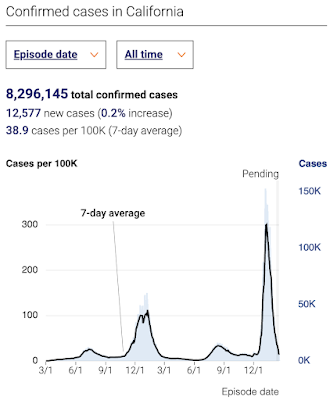
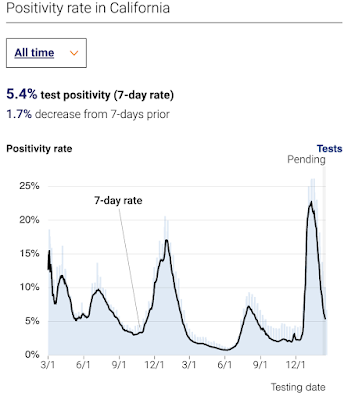
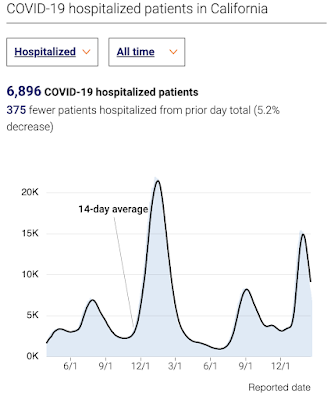
Be careful out there, everyone! Get those vaccines, get those boosters, wear a GOOD mask when you're in an indoor space, or even in a crowded outdoor space.
Take it from someone who did all that, and is still working to recover from a bout of COVID himself...
Wonderful article on Reuters (with lovely and very informative graphics) about the work to repair the Tonga cable: The race to reconnect Tonga
The 827 km (514 miles) cable from Fiji to Tonga is one of 436 active undersea cables that connect the globe.
...
Most cable damage occurs due to ship anchors or fishing trawlers and occasionally environmental factors such as earthquakes.
Faults are common and typically most traffic would be rerouted to another cable. However, in Tonga’s case, there is only one cable connecting the country.
...
The fibre optic cable isn’t easy to fix. A technician splices the glass fibres and uses glue to attach the new section of the cable. This fibre optic splicing can take up to 16 hours and is the most crucial aspect of the repair work.
...
A remotely operated vehicle (ROV) may descend to the seabed to inspect and help bury the cable, although they can only work to a certain depth. In the case of the Reliance, the vehicle can descend up to 2,500 meters.
Happened across these for various random reasons, and enjoyed them.
In early 2020, when the global response to Covid-19 mandated national lockdowns and stay-at-home orders, online gaming had a huge boom. Friends celebrated birthdays inside Animal Crossing: New Horizons. Gamers introduced family members to browser party games to keep in touch.
...
"Quarantine happened and a lot of people weren't able to see their horses," Farace explains. She was frequenting a Facebook group of horse-loving gamers at the time, and a post caught her eye. "Red Dead people were like 'let's have online trail rides!'"
"With RDR2 having some of the most beautiful horse models in video games, topped off with beautiful motion captured animations and a breathtaking wilderness, it's a blast to take pictures in this game." It was by uploading her photos to the Rockstar Social Club that Sunny met another member of The Rift and started joining in on trail rides.
The game itself covers the famous WWII operations in Libya and Egypt between 1940 and 1943. Along with the opaque rulebook, the box includes 1,600 cardboard chits, a few dozen charts tabulating damage, morale, and mechanical failure, and a swaddling 10-foot long map that brings the Sahara to your kitchen table. You’ll need to recruit 10 total players, (five Allied, five Axis,) who will each lord over a specialized division. The Front-line and Air Commanders will issue orders to the troops in battle, the Rear and Logistics Commanders will ferry supplies to the combat areas, and lastly, a Commander-in-Chief will be responsible for all macro strategic decisions over the course of the conflict. If you and your group meets for three hours at a time, twice a month, you’d wrap up the campaign in about 20 years.
...
“Every military division has a sheet of paper, and on it you’ve got a box for every battalion. It’ll tell you how many guns you have, but more interestingly, it’ll also list the fuel and water. Every game turn, three percent of the fuel evaporates, unless you’re the British before a certain date, because they used 50-gallon drums instead of jerry cans. So instead, seven percent of their fuel evaporates,” explains Phipps.
...
We’re in the midst of a tabletop renaissance. Global board game sales have boomed over the past few years, and a renewed interest in the hobby has seeped into coffee shops, video game publishers, and publications like ours. Despite that, the classic hexagonal historical war-game—the true bones of the industry—are a dying breed. This is the Catan generation: millennials weaned on the crisp, instinctual gameplay perfected by the German masters. Phipps has fond memories of the late-’70s “the golden age” of war-gaming - where publishers routinely tried to out-convolute each other with their designs, because surely, the more complex a game is, the grander it must be. “After that golden age the designs got better,” he says. “But at the time there’s this sense of excitement, everything is new and possible.”
Ah, delightful: Sea Chase.
References, for you mapping nerds out there (pretty sure none of you read my blog anyway):
