Saturday, August 12, 2023

Young Adam: a very short review

Can a book be both horrible and yet also magnificent?

I don't know, somehow it seems that the horrible must be strictly separate from the magnificent, and there can be no overlap.

But if you accept that the concept is at least plausible, then surely Alexander Trocchi's Young Adam is such a book.

Trocchi was Scottish, but he spent most of his literary life in Paris and New York, simultaneously celebrated and controversial. Much of his work, including an early version of what became Young Adam, was published under pen names, as it was deemed vulgar, even pornographic.

But Young Adam is certainly not pornography; it is something else entirely. Written entirely in the first person, it tells the story of a short period of a few months in the life of Joe Taylor. Joe is a laborer, but not a tailor; most of the book involves a temporary job he has taken working in a coal barge which is delivering a load on the River Clyde.

Things happen, not exactly to Joe, but also not exactly apart from Joe either, and those events, together with Joe's thoughts about them and reactions to them, fills the pages of this short book in a blurry, dreamlike, feverish way.

The things that happen are terrible, dreadful, vile things, and yet to Joe they are just the course of life, and his descriptions of how things seem is vivid but yet also distant and gauzy, as though everything is real and fantasy all at once. Here's Joe talking about what it's like to wake up in a bunk on a bed:

The slow lick of the water against the belly of the barge was still present when I awoke, as though during the night it had guarded the connection between states of waking and sleeping, the noise of the water only, for my cabin had changed under the pale log of light which entered at the port, defining clearly the greyness of the blanket, the chipped varnish of the plank walls which closed me in. Often when I woke up I had the feeling that I was in a coffin and each time that happened I recognized the falseness to fact of the thought a moment later, for one could never be visually aware of being enclosed on all sides by coffin walls. As soon as one saw the walls, as soon as light entered one would no longer be cut off and so the finality of the coffin would have disintegrated. And then I would be conscious again of the sound of the water and of the almost imperceptible movement of the barge in relation to it.

How masterful this paragraph is!

I can't stop admiring the exquisite skill with which Trocchi delivers this. At the start of the paragraph, we are sound asleep, having some sort of strange sensual dream about being our belly being licked by the water, being caught between life and death ("waking and sleeping"), frozen in an underworld vision. But it's not a happy dream! Joe dreams he is "guarded" from some "connection", and the horror of this dream is vivid and gripping: Joe is certain he is dead and yet somehow experiencing life from within his coffin. Even as he is waking up, he is still having nightmares: the light itself becomes a fantasy creature of some sort with its own agency; it is a "pale log" which has "entered". Then suddenly Joe is awake, and he realizes he was just having a dream, and now the "finality of the coffin" has disintegrated. At first he thinks it's the light itself which has done this, but then he understands that all of his senses are involved: "the sound of the water", the "movement of the barge", even the feel of the blanket on his bed is part of this blurry transition from the dreamworld to the real.

Joe sees the world through a strange and demented perspective, and yet in Trocchi's masterly handling you find yourself inhabiting Joe's mind, sifting through the perceptions he makes as he passes through life, having psychotic breaks that burst open and then vanish as quickly as the rest of us might take a breath or scratch an itch. Just simply doing his crew-work on the boat is a strobe-lit sequence of ghastly visions:

Up on deck the air was cool, cool grey, and over behind the sheds the brick factory stack was enveloped in a stagnant mushroom of its own yellow smoke. Leslie spat out over the side of the barge and put away his pipe.

I'll start her up, then," he said, and went below again.

I let go of the ropes and soon we had moved out into the yellow flank of the river into midstream and were heading for the entrance to the canal. The water was smooth and scum-laden and it seemed to lean against us and fall again, the surface broken with scum-spittles, as we made way. Now and again a piece of pockmarked cork moved past low in the water. There wasn't much traffic on the river. And then, under the dirty lens of sky, Leslie was looking intently towards the quay from which we had just pulled away, marking in his memory, I suppose, the stretch of water from which we had pulled the woman's corpse.

Now, it is boring when you get used to it to crawl along a canal, to wait for a lock to open, for water to level, but you see some interesting things too, like the cyclists on the footpaths where a canal runs through a town, and kids playing and courting couples. You see a lot of them, especially after dusk, and in the quiet places. They are in the quiet places where there is no footpath and where they have had to climb a fence to get to. Perhaps it is the water that attracts them as much as the seclusion, add of course the danger. In summer they are as thick as midges, and you hear their laughter occasionally toward evening where the broken flowers spread down the bank and touch the water, trailing flowers. You seldom see them: just voices.

Wow! How do you even start to comprehend this section? We start out in a "cool grey" industrial catastrophe, with smokestacks and sheds and a "stagnant mushroom". We can't really tell if this is really the docks by the river or captain Leslie's pipe. The odd repetitions of language ("into the ... flank ... into midstream", "lean ... and fall again") set up a metronymic rhythm that begins to thrum within us. There "wasn't much traffic", but the otherwise peaceful departure of the barge from his moorings then startlingly veers wildly from "smooth" to "scum-laden", with its "scum-spittles" and "pockmarked cork". And then, suddenly, out of the blue (or, rather, out of the "dirty lens of sky"), suddenly "the woman's corpse" is there in Joe's mind. And then, immediately gone again, for we're back to being "boring" as we "crawl along" and "wait ... for water to level". How much more boring can things be? It's like watching paint try. There are "footpaths" and "kids playing", and you "get used to it", emphasized by the rhythmic repetition of the "quiet places". And then, suddenly once more, "the danger"! With shock you realize that although there is "laughter" and "courting" and "flowers", we have crossed some horrible, horrible boundary (we "have had to climb a fence to get to" it!), and these are "broken" flowers telling you about the real "danger" in these quiet places.

Oh you simple-minded reader, who thinks that the peaceful riverside is a place of peace and happiness, what little you know of the demons in Joe Taylor's mind, and what he sees in this pastoral sweetness.

Near the end of the book, Joe goes on a tirade, ranting about the injustice of it all, watching the criminal justice system condemn an innocent man. But in fact it is Joe himself who has done this, and here he stands in for Mr. Everyman, blaming the "system" for faults that in the end trace back to individuals.

The social syllogism in which Goon had been unfortunate enough to get himself involved upset me deeply. If any act of mine could have destroyed that syllogism, I should have acted gladly. Go to the police? Confess? In practice I knew it would prove fatal to me. In principle it would have been in an indirect but very fundamental way to affirm the validity of the particular social structure I wished to deny.

Ah yes, practice and principle. Messy subjects. Joe's rationalization infuriates us and yet barely surprises us, having spent 150 pages deeply inhabiting his mind.

Reading Young Adam is a funny experience, for if you are as me you feel compelled to race along, to keep up with Joe's feverish descent into madness, to go there with him and experience it all unfold. And yet, it is all so vivid, and so bitterly and dreadfully immediate, with that "what's around the next corner" feeling, that you want to take the book as slowly as possible, and drink in every horrifying phrase and description.

If you ask me whether you should read this book or not, I don't really know what to tell you.

It was a deeply moving experience for me.

But you must make your own decision.

Friday, August 11, 2023

Saturday, August 5, 2023

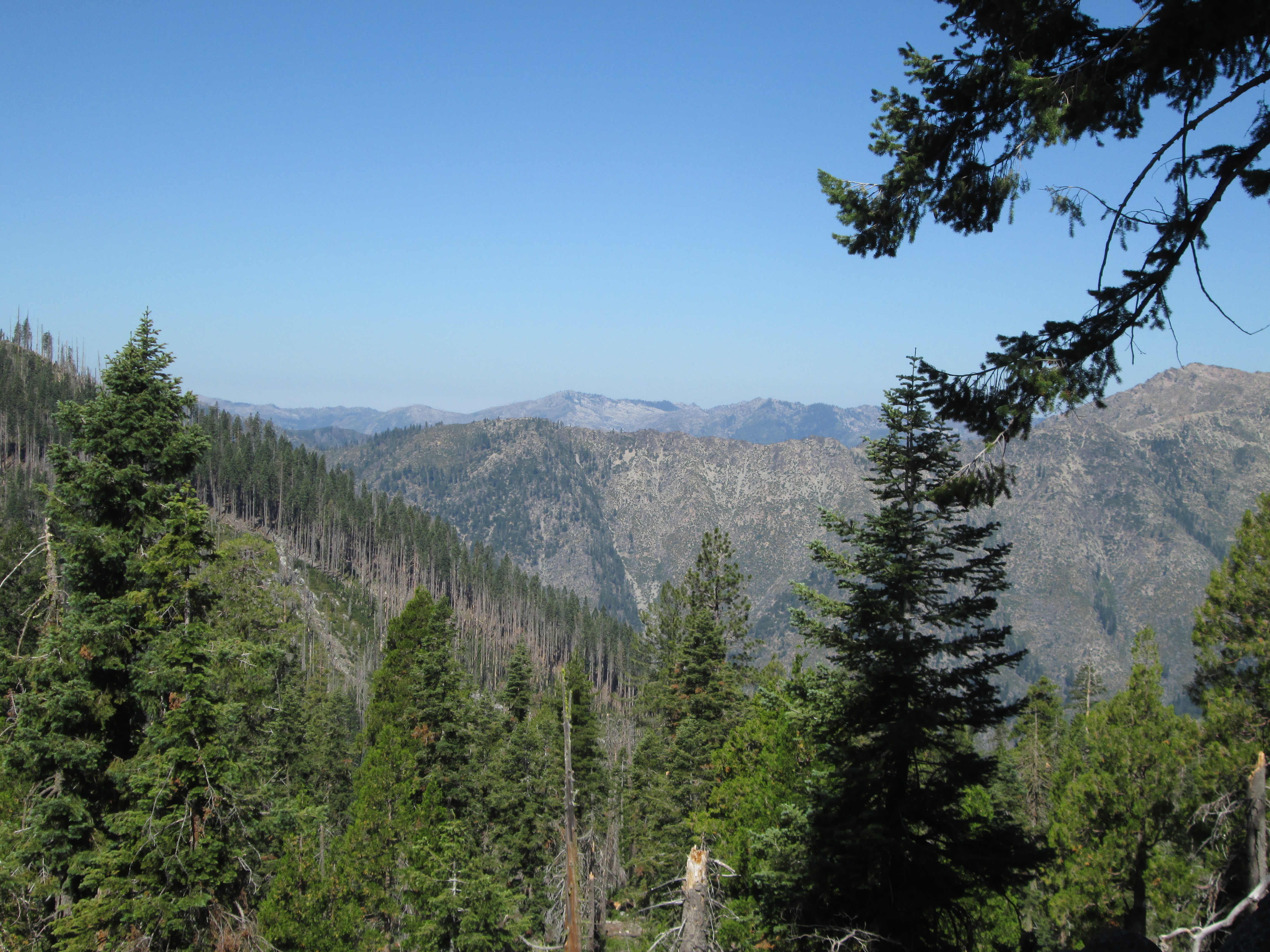
Backpacking 2023: Hogan Lake, Russian Wilderness

It was time to go, so we packed up and went.

As you'll recall, last year our trip was canceled by the McKinney fire.

But we still wanted to go on that trip, so we tried again. And this time everything was different. There was no fire, there was no smoke, there were no road closures. There was simply blue sky and clear air.

The Russian Wilderness is one of the smallest and least-visited of California's Wilderness Areas, for reasons well-described by its wilderness.net page:

Elevations range from 4,800 feet to Russian Peak's 8,200 feet. An extensive trail system generally crosses steep and rocky ground, difficult going for stock animals. Stock forage is limited in most of the lakeside campsites. The Pacific Crest Trail (PCT) runs the entire length of the area north-south for about 17 miles, but stays high with few campsites and snow until late in the season.

We visited the Russian Wilderness once before, eight years ago, and stayed mostly in the south-eastern part of the wilderness. On that trip we took a day hike and got to a spot on the Pacific Crest Trail where we could see the other part of Taylor Lake, which is the primary access point (besides the PCT) to the north-western part of the wilderness.

To get to the Taylor Lake trailhead, you first go to tiny Etna, CA, then you find the Sawyers Bar road, well-known among aficionados of crazy mountain roads.

The drop down the back side touches 18%. The road is very rough and mostly one lane. The speed is very slow most of the way, like 10-15 mph. The road is really remote and almost no services are available. It can get bloody hot on summer afternoons. Sound horn on all blind curves. Not recommended for campers, trailers, or drivers inexperienced in mountain driving. No services for 40 miles.

Happily, we didn't drive that section of the road, for the Taylor Lake trailhead is accessed by a Forest Service dirt road (quite the experience itself; watch out for the cows!) which splits off from the Sawyers Bar road just after you reach Etna Summit. We spent about 30 minutes hanging out at Etna Summit (which has lovely views), while we waited for our second vehicle, which had accidentally started off on French Creek road, which takes you to the other side of the wilderness area (luckily they figured out that mistake quickly).

The trail from Taylor Lake trailhead to Hogan Lake is not complicated to describe:

  • You first hike 0.3 miles, mostly flat, on a wide and well-traveled trail up to Taylor Lake.
  • At the fork, where the main trail goes around the east side of Taylor Lake and up to the PCT, you instead choose the trail around the west side of Taylor Lake, which almost immediately proceeds up a steep ridge to a saddle at just above seven thousand feet. During this part of the trip you gain about 500 feet of elevation, and the trail is clear and well-maintained.
  • Beyond the saddle, the trail plummets! It rapidly descends nearly 1,000 feet, snaking along ridgelines, blasting through immense fields of manzanita, hurdling immense basalt and granite boulders, vaulting innumerable downed trees. Quite the obstacle course.
  • But there are no more forks in the trail, you simply follow it to the end, where you find Hogan Lake.

The entire route from trailhead to Hogan Lake is about 4 miles, and with full packs it took us several hours, with breaks along the way to admire the views and have lunch and whatnot.

Because Hogan Lake is pretty much the only place you can easily go from Taylor Lake trailhead, it is relatively popular, and indeed we met a quite large group of "Dads and Lads" (as they called themselves) along the trail.

Happily, they were going the other direction on the trail, for they had just finished their trip, and for the most part we had Hogan Lake to ourselves.

Hogan Lake is relatively shallow, and was surprisingly warm and very pleasant for swimming. It was full of fish and frogs and tadpoles and what (I think) were California newts? (We chose not to sample the toxin from their skin to verify.)

On the internet, you'll find many articles about how to visit nearby Big Blue Lake from Hogan Lake, an adventure which requires ascending a 900 foot canyon face, with no trail, littered with huge fields of scree and sharp boulders, and no shade along the way.

We could see the canyon face clearly from our campsite near the lake, and we certainly wanted to see Big Blue Lake, so we bravely set out on the approach.

But we didn't make it very far.

In fact, even just traveling around the lake shore to the far side of Hogan Lake was quite challenging for us! Unlike many California mountain lakes, there were no casual trails around the lake through the thick and thorny lakefront bushes, and every step we took was fraught with challenge.

And Hogan Lake was so warm, and beautiful, that in the end we didn't truly regret that we couldn't see the other nearby sites; what we found there was pleasant and just what we needed.

Tuesday, July 25, 2023

Some interesting things happening in Major League Baseball this year...

...

I don't follow professional baseball very much, but I am paying attention to at least two things. The first one is much more interesting than the second, but I find them both interesting.

Firstly, Shohei Ohtani !! He was great last year, but this year he is somehow beyond great.

Secondly, we are now 100 games through the 2023 season, and all five teams in the American League East are above .500.

Enjoy the pennant race, everyone!

Yes, yes, the one thing we can be certain of is that the Oakland Athletics will not be in the playoffs this year.

Monday, July 17, 2023

Whiskey Flat is gone again

The Lake Isabella region is changing again.

For centuries, probably for millenia, the mid-mountain valley that drains the Kern River was settled by various peoples.

This dramatically changed with the discovery of gold in the early part of the 19th century and then again after the Civil War, when refugees from the war's devastation drifted westward to the open land in the west, leading to conflict in this (relatively) peaceful area.

Around 75 years ago, this part of California was changed again by the construction of the Isabella Dam, built to control the raging Kern River which had flooded Bakersfield many times.

I used to travel this area fairly frequently, when some of my family lived in the high desert area near Ridgecrest, and they would tell me about this history of the dam and the valley and how it had many stories.

More recently, the dam became damaged, and a 15-year reconstruction project required that the lake level be dramatically lowered.

Still more recently, a series of drought years lowered the lake level still further, to the point that the lake contained only a mere eight percent of its storage capacity, with the result that previously-submerged towns underneath the lake began to become visible again.

Knowing how to find these locations is a bit of an art:

"You can easily locate it by finding the foundation of the old church and a cistern that was on the hill above Brown's stable," Anderson said. "Old Kernville is between New Kernville and Wofford Heights."

Anyway, these parts of central California had been very popular from the late 19th centry through the middle of the 20th century, as you can see in the wonderful pictures in this SFGate article. There were farms and ranches, towns with markets, churches, government buildings, and so forth. And the area was well-known for making "western" movies celebrating the (mostly fictional) cowboys-and-indians stories that were very popular and built the careers of actors like John Wayne and Clint Eastwood.

Damming the river and filling Lake Isabella mostly ended this era of the region's history, although people still gather yearly for a celebration of "Whiskey Flat Days".

But last winter, as everyone knows, the rains and snows came in tremendous volume! Happily, the restoration project has finished, and the Isabella Dam is back to its intended role.

And Whiskey Flat has sunk back below the lake's surface.

Which is good, because the snow is still melting!

Mulkay, who acts as the liaison between water rights holders downstream and the Corps of Engineers, said returning full storage capacity to the reservoir will give water managers more flexibility in their water management strategies.

Considering this year's massive snowpack and huge river flows, many had predicted Isabella would be filled by mid- to late June. But a mild late spring and the Corps' decision to push larger-than-normal releases from the dam gave water managers more breathing room.

"There is still a lot of water in the snowpack," Mulkay said, "and a very conservative estimate of runoff for July and August is in the range of 350,000 acre-feet and 110,000 acre-feet, respectively.

Not sure when I'll make it back through this area again, as my family has moved and it's no longer an area I visit regularly.

Still, it's good to know that the dam is safely repaired, as I've still got family in Bakersfield!

Friday, July 7, 2023

The more you learn about Rust, the more you find to learn

Over the last several months, I've been continuing to study Rust, the programming language that is taking over the (systems) programming world.

I probably shouldn't put that word "systems" in parentheses, however. I'm not sure if it's just a reflection of my interests (I've pretty much only ever been a systems programmer), or if it says something a bit deeper about Rust, but most of the interesting material I find about Rust is very much oriented to systems programmers.

Anyway, here are a few references since the last time I wrote.

I'm learning so many things about Rust by trying to learn Rust.

But the marvelous thing is to be simultaneously learning so many other great ways of looking at how to write great systems software.

Which is a topic that never gets old.

Wednesday, July 5, 2023

Dead and Company Boulder Colorado 2023

Man I had a nice summer trip to Colorado!

My favorite part was the Mickey "rap" on night 2. My second favorite part was Dave Matthews on the last night joining for the final 4 songs. My third favorite part was the Dear Mr Fantasy/Hey Jude segment on night 1. My fourth favorite part was The Eleven, which is a very weird song but since you almost never hear it played live that's a special treat. My fifth favorite was another glorious version of Morning Dew, which has grown on me over the decades to become one of my all-time favorite songs, tragic and depressing though it may be.

But it was all wonderful!

I'm still quite sleep-deprived and foggy-eyed, but these nice reviews captured the scene very well: